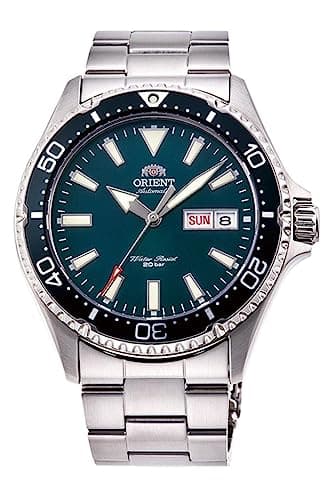
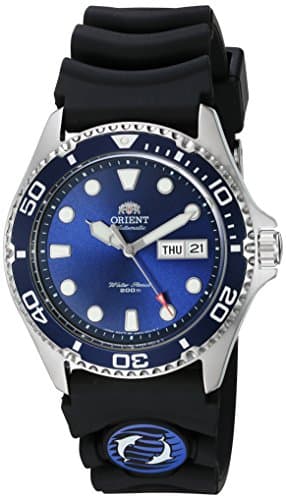
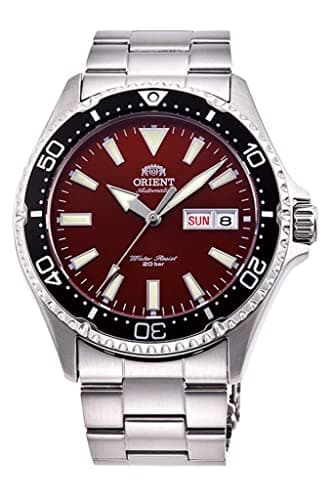
Orient is owned by Seiko Epson and builds its own movements, and its dive watches are the best specification-per-dollar in the affordable watch world. All three below use the same in-house F6922 automatic — it hacks and it hand-winds, which not every affordable automatic does — in a 200m case with a screw-down crown and a 22mm lug width. They are, in the ways that matter, the same watch three times.
So this page is really about the differences, and there are exactly three worth your attention: the crystal, the dial, and the price. The Kamasu has a sapphire crystal; the Mako III and the Ray II have mineral. That is the whole ranking, and everything else is taste. Our broader Orient brand roundup covers the dress references too; this page is the divers only, on the dive hub, with the lug-to-lug figures in the table.
Every spec below is a published Orient figure. If you are choosing between two of these three specifically, we have the head-to-heads: Kamasu vs Mako and the Kamasu review go deeper on the dial and bezel differences than a roundup should.
The sapphire is the whole argument
Sapphire scores 9 on the Mohs scale against 5 to 6 for mineral glass, which in practice means it resists the everyday scratches that eventually haze a mineral crystal. It is rare below three hundred dollars — our sapphire roundup keeps a deliberately short list for that reason — and the Kamasu is the cheapest 200m automatic diver we rank that has it. If you buy one Orient diver and keep it for a decade, buy that one.
The counter-argument is real too. Mineral glass is easier and cheaper to replace, and it is less likely to shatter from a sharp knock than sapphire, which is harder but more brittle. If your watch is going to take abuse rather than wear, the Mako III and Ray II are not worse buys — they are different ones.
Fit: the Kamasu is the shortest across the wrist
The three case diameters are within half a millimetre of each other, so the figure that actually separates them is lug-to-lug: Orient publishes 46.8mm for the Kamasu against 47mm for both the Mako III and the Ray II. That is a small difference but it runs the same direction as the case size, so the Kamasu is the best of the three on a smaller wrist. All three are 22mm at the lugs, so any strap fits any of them — see our small-wrist dive picks if fit is the deciding factor.
What Orient does not publish
Two things, and we are not going to fill them in. Orient publishes no luminous compound and no glow duration for these dials — only "luminous hands and markers" — so we do not rank them on lume, and our lume roundup says so on the page. And none of the three carries a published ISO 6425 certification: the 200m rating and the screw-down crown are real specifications, but Citizen's Promaster line makes the stronger, certified claim. Our Kamasu vs Promaster page gives Citizen that point on a page the Orient wins overall.
Which one, in one line each
Buy the Kamasu unless you have a reason not to — sapphire, the shortest lug-to-lug, applied markers. Buy the Mako III if you prefer its dial and want to save a little. Buy the Ray II if you want the plainest dial of the three and the lowest price, and you accept mineral glass. There is no bad answer here, which is an unusual thing for us to be able to write.
How we picked
We do not run a testing lab
We compiled the published manufacturer specifications for every watch here — case size, lug-to-lug, lug width, water resistance, movement and crystal — did the wrist-fit and value math, and scored each pick against a published rubric. The scores are judgments from documented research — they are not measurements we took or wrist-time we logged, because we do not have these watches and we are not going to pretend we do. Where a spec could not be verified we wrote "data unavailable" rather than guessing.