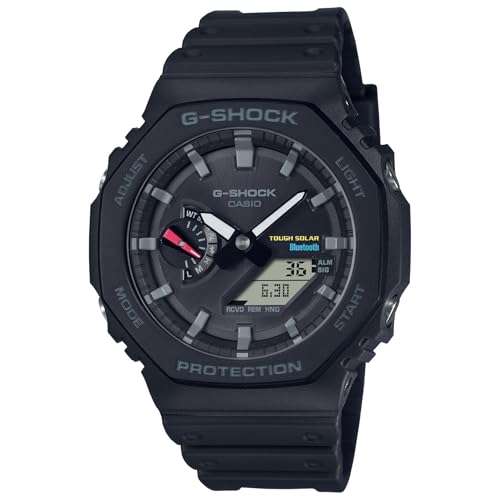
The awkward thing about ranking G-Shocks is that the headline specifications are the same on all of them. Every watch on this page carries Casio's shock-resistant construction and a published 200-meter water-resistance rating. Every one has a mineral crystal. Every one is quartz, so there is no movement hierarchy to argue about. A roundup that led on toughness or water resistance would be ranking five watches that tie.
So this page ranks them on what genuinely differs, in this order. First, what you have to do to keep it running and keep it right — a solar cell plus a radio or phone time signal means you never open the case and never set the watch, and that is the single biggest practical difference in the line. Second, thickness and weight, because the reason people own a G-Shock and still do not wear it is that the old shapes are over 14mm tall and the new ones are not. Third, price, which on this page spans roughly threefold for the same rating. Fourth, the features only some of them have: world time, atomic timekeeping, an app.
Every figure in the spec table is Casio's own published specification for the exact reference, taken from its product pages. Where Casio publishes nothing for a field, the cell reads "—" rather than a number we invented. One note on how we read Casio's format: it publishes case size as length × width × height, so the figure in our "Case" column is its width and the figure in "Lug-to-lug" is its length — the measurement that actually decides whether a watch overhangs your wrist.
And one honest caveat before the picks, because it matters more on this site than on most. Not one of these watches takes a standard strap. Every band here is a proprietary resin strap bolted into a resin case. If part of the appeal of a watch for you is the drawer of straps you already own, a G-Shock is the wrong purchase, and we would rather say so in the introduction than bury it in a con list.
The criteria, in the order we weighted them
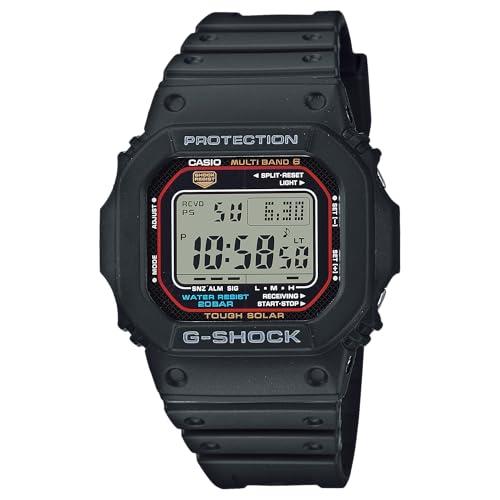
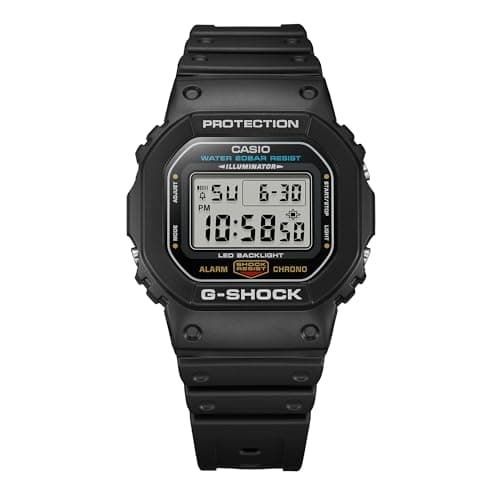
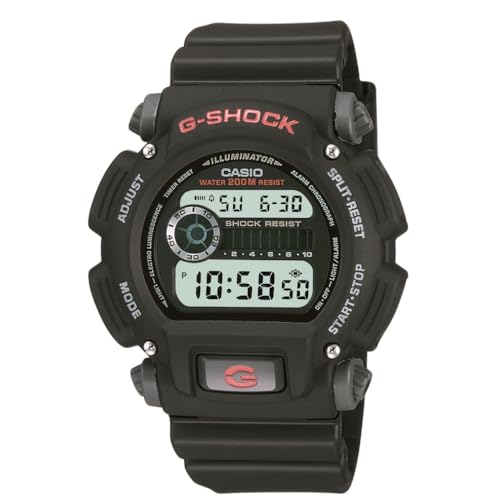
1. Power and time-setting. Three of these five need something from you. The DW-5600 and the DW-9052 run on a cell you eventually replace, and you set them by hand. The GW-M5610U runs on Tough Solar and takes a radio time signal; Casio publishes automatic reception up to six times a day, so the watch corrects itself overnight. The GA-B2100 runs on Tough Solar and sets itself from a phone over Bluetooth. If you own several watches and a G-Shock will sit in a drawer for months at a time, this is the criterion that should decide your purchase, and it is why the two self-setting models rank where they do.
2. Thickness. Casio's published heights for the five, in order: 11.8mm for the GA-2100, 11.9mm for the GA-B2100, 12.7mm for the GW-M5610U, 13.4mm for the DW-5600 and 14.7mm for the DW-9052. That is a spread of nearly 3mm, and on the wrist it is the difference between a watch that goes under a shirt cuff and one that catches on it. Published weights follow the same pattern: 52g for the GA-B2100 and the GW-M5610U, 59g for the DW-9052.
3. Price. The cheapest pick here costs roughly a third of the dearest, for the same published rating and the same construction. We think the solar, self-setting models earn their premium, but it is a premium for convenience, not for toughness, and anyone who tells you the dearer G-Shock is the tougher G-Shock is wrong.
4. Features. The GA-B2100 publishes 38 time zones on the watch itself and roughly 300 world-time cities through Casio's app. The GW-M5610U publishes 31 time zones and Multi-Band 6 radio reception. The two plain digitals give you the stopwatch, the timer and the alarms and nothing more. If you travel, the top two are the picks; if you do not, the feature list is close to irrelevant.
Two shapes, four of five watches: the square and the octagon
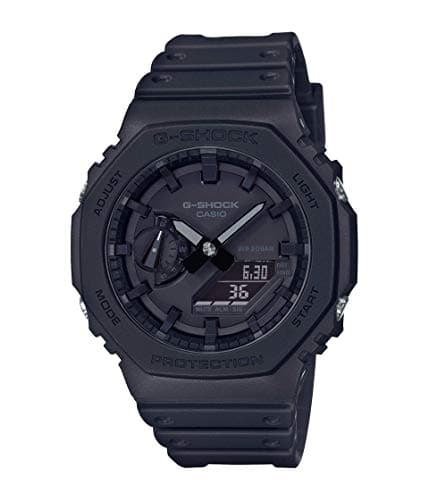
It is worth naming the structure of this list openly, because it looks repetitive until you see what it is doing. Four of the five picks are two designs in two versions each. The square is the 5600 lineage — the shape of the original 1983 watch — and it appears here as the battery-powered DW-5600 and as the solar, radio-set GW-M5610U. The octagon is the 2100 series, and it appears as the plain GA-2100 and as the solar, Bluetooth-equipped GA-B2100. In both pairs the case is effectively the same case; what the extra money buys is the power source and the time-setting.
That is the most useful thing to understand before you spend. The decision is not "which G-Shock is best" — it is "which shape do I want, and will I pay roughly fifty dollars more never to touch it?" Our head-to-head on the DW-5600 against the GA-2100 covers the shape question in detail; this page adds the two solar versions that comparison does not include.
What "shock resistant" and 200m actually mean here
G-Shock's shock resistance is a construction claim, not a number: a module suspended inside the case so impact energy travels through the resin and the case structure rather than into the movement. Casio publishes it as a construction attribute — on the GA-B2100 it is listed as "Shock Resistant" with a Carbon Core Guard structure — and it is the one thing on this page that nothing else in our registry replicates. It is also not a measurement we can verify ourselves, so we carry it as Casio's own published claim and nothing more.
The 200-meter rating is a different kind of claim and a better documented one. All five watches publish 200m, which on our water-resistance scale is as much as almost anyone needs. What none of them publishes is an ISO 6425 diver's certification, which covers the bezel, the crown, legibility in darkness, salt water and shock rather than pressure alone. If you want a certified dive instrument rather than a 200m-rated tough watch, the page to read is what makes a watch a dive watch, and the pick is a Citizen Promaster rather than anything here.
Fit: these are wide watches, and the 2100 is the one that hides it
Casio's published lengths put the two 2100s at 48.5mm, the DW-9052 at 48.5mm, the DW-5600 at 48.9mm and the GW-M5610U at 46.7mm. By the standard we use everywhere on this site — the lug-to-lug span, not the diameter — the square GW-M5610U is the smallest watch here by more than 2mm, and the DW-5600 is the largest. But the figure that decides how a G-Shock actually wears is height, and there the 2100 cases win by a wide margin: 11.8 to 11.9mm against 13.4 and 14.7mm.
Practical reading. If you have a smaller wrist, the GW-M5610U is the pick, and the squares generally wear better than their width suggests because the resin case tapers sharply. If you want a G-Shock that can be worn with a jacket, it is a 2100 and nothing else. Our watch size for your wrist guide explains why we rank length over diameter, and the best digital watches is the page to read if you want smaller digital options outside the G-Shock line entirely.
The strap problem, stated plainly
This site is built around lug width — the measurement that tells you which strap fits. On this page that measurement does not exist. All five of these watches use a band bolted into the case through a proprietary fitting, and Casio publishes a band size range (145 to 205mm on the GW-M5610U) rather than a lug width. G-Shock-specific replacement bands and adapter kits are sold, but nothing from our 22mm or 20mm roundups will fit any of them.
If that is a dealbreaker — and for a lot of people it should be — read G-Shock alternatives instead. That page covers the tough watches that do take a standard strap, and it is honest about the fact that none of them matches the shock-resistant construction you would be giving up.
What is not on this page, and why
No Mudmaster, no Rangeman, no Frogman, no full-metal GM-2100, no MT-G or MR-G. All of them are real G-Shocks and several would belong on a list like this. None has a verified live listing in our registry at the time of writing, and we do not rank a watch we cannot price for you from the live feed. The same applies to the DW-6900: a listing exists, but we could not read Casio's published specification for the current U-revision reference, and we would rather leave it off than print a spec table built on the previous module's figures. If that changes, this page changes.
Two of the five picks here also appear on our Casio brand roundup, which ranks the whole catalog rather than the G-Shock line. This page exists because that one has to give its slots to analog Casios, solar Casios and the vintage digitals, and a reader who has already decided on a G-Shock needs the three solar and self-setting references it does not cover.