"Citizen Promaster" is not a watch. It is a family, and the thing that trips people up is that the family does not share a lug width. Citizen publishes 20mm for the 41mm Promaster Dive Automatic (NY0129) and 22mm for the 45mm Promaster Dive Eco-Drive (BN0191), the 44mm Promaster Dive Super Titanium (BN0200-56E) and the 45mm Promaster Skyhawk A-T. Two of the most popular Promasters in our registry are two millimeters apart, which is why every pick on this page is listed with its width range rather than a single number.
A second fit note that matters more on the Eco-Drive divers than people expect. The BN0191 is a 45mm watch with a published 48.8mm lug-to-lug, and the NY0129 is a 41mm watch with a published 50mm lug-to-lug — the smaller case has the longer span. That inversion is a Citizen quirk we have documented on the Citizen diver roundup, and it has a strap consequence: on the NY0129 a long, stiff strap will overhang a small wrist even though the case looks compact. A supple rubber or a single-pass nylon is the safer choice there.
The criteria this page ranks on, in order. First, does it come in both 20 and 22mm — a strap that only fits half the family is a worse recommendation. Second, the stated material, because "rubber" covers everything from FKM to unspecified TPU and the difference shows up in a year. Third, the hardware: quick-release bars, the clasp on a bracelet, the buckle on a nylon. Fourth, whether it suits a watch with a published dive rating, which is the whole point of a Promaster. Fifth, price — and on this page the cheapest pick costs less than a tenth of the dearest.
One thing we will not do is tell you the Nighthawk's lug width. Citizen does not publish one for the reference in our registry, and our spec table shows "—" rather than a number we guessed. If you own a Nighthawk, measure the gap between the lugs with the measuring method here before you order.
Which Promaster do you have? The widths, listed
From Citizen's own published specifications, as carried in our registry: Promaster Dive Automatic NY0129 — 41mm case, 50mm lug-to-lug, 20mm lugs, 200m to ISO 6425, mineral crystal, Citizen 8204 automatic. Promaster Dive Eco-Drive BN0191 — 45mm case, 48.8mm lug-to-lug, 22mm lugs, 200m ISO compliant, mineral crystal. Promaster Dive Super Titanium BN0200-56E — 44mm case, 22mm lugs, 200m ISO-compliant, mineral. Promaster Skyhawk A-T — 45mm case, 22mm lugs, 200m, sapphire. If your Promaster is not one of those four, measure it.
1. Rubber: FKM is the specification to look for
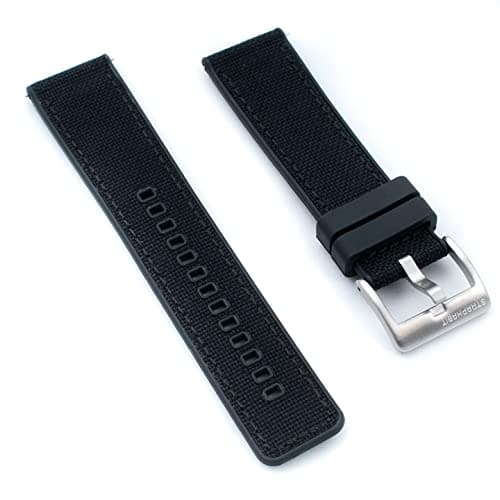
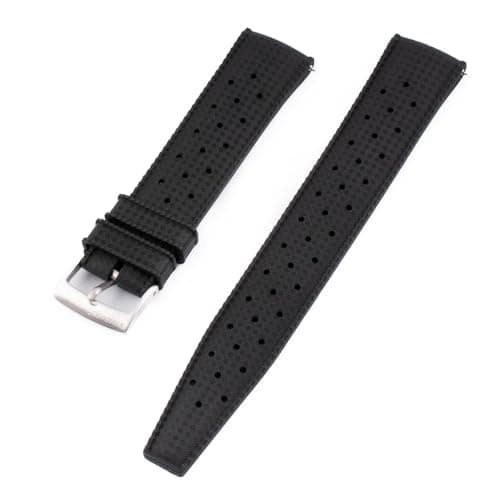
A Promaster is a dive watch and rubber is the honest default. The word that matters on the listing is FKM — fluoroelastomer — rather than "silicone" or just "rubber". FKM is denser, far less prone to the chalky bloom that silicone develops, and it does not grab lint. Our top pick states FKM and publishes 18–24mm with the 22mm version tapering to 20mm at the buckle, which is the detail that makes a thick rubber strap wearable on a 45mm watch. The FKM against silicone comparison sets out the trade, and the tropic roundup ranks the whole category.
2. Steel: a straight-end bracelet, and why that matters here
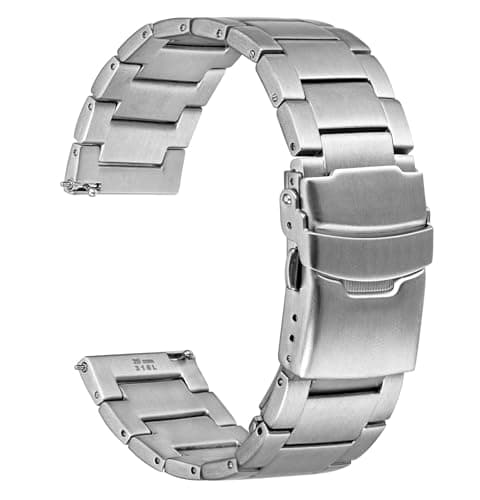
The Promaster cases in our registry take a straight-end bracelet, which is good news: a straight-end bracelet is sold by width and fits any watch of that width, whereas a curved-end bracelet is cut for one specific case and leaves a gap on anything else. Our bracelet pick publishes 316L stainless in 20 and 22mm with a double-lock clasp, which is the right hardware on a watch you might actually swim in. If you want the full bracelet comparison, including the model-specific curved-end options, the bracelet roundup is the page.
3. Mesh: the under-appreciated dive option
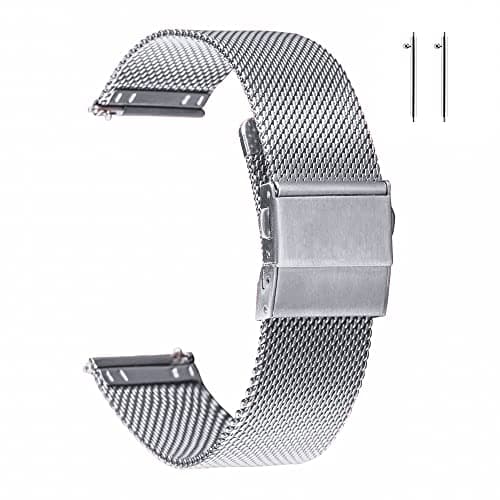
Woven steel mesh is the oldest dive-bracelet idea there is and it still works: it is comfortable wet, it dries quickly, and a mesh with quick-release bars is the easiest steel option to fit at home. Our mesh pick publishes 18–22mm with quick-release bars, so it covers the NY0129 at 20mm and the Eco-Drive divers at 22mm. The caveat is clasp quality, which is where cheap mesh gives itself away; see the mesh roundup for how the clasps compare.
4. Nylon: the cheapest way to change the watch completely
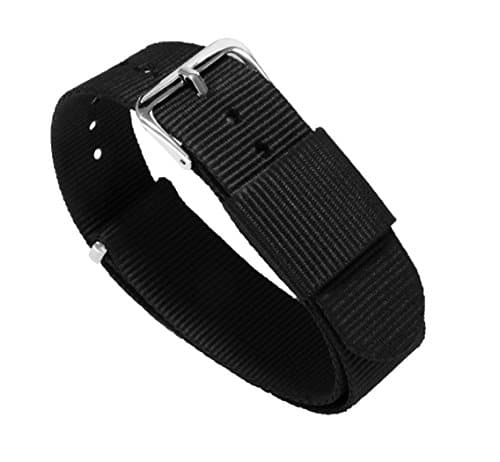
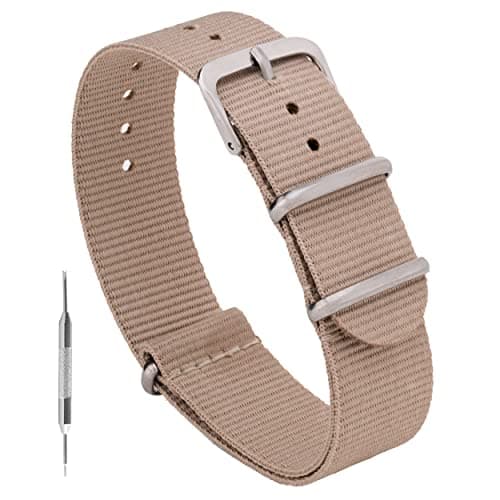
A single-pass nylon has two real advantages on a diver. It is the only strap style where a spring bar failing does not drop the watch, because the strap runs under the caseback. And it is cheap enough to own in four colors. Both nylon picks here publish 18–24mm, so width is not a consideration. The trade is thickness: a NATO adds a couple of millimeters of height under the case, which on a 45mm BN0191 is noticeable. See the NATO roundup and NATO against Zulu for the hardware differences.
The quick-release question
Four of these six publish quick-release bars, which means you can change the strap with a thumbnail and no spring-bar tool. On a watch you swap seasonally that is worth paying for; our quick-release roundup covers the mechanism and its one weakness, which is that the lever is a moving part on a strap that gets wet. The two NATOs do not need bars at all — they pass through the existing ones. If you are fitting a strap for the first time, read how to change a watch strap first.
What is not on this page
No leather. You can absolutely put a leather strap on a Promaster and it looks good on the titanium BN0200 in particular, but a leather strap on a watch bought for its dive rating is a compromise we would rather flag than rank: leather and salt water are a bad combination, and the rating does not care but the strap does. If you want one anyway, start with the leather roundup and buy the width your Promaster actually takes. And no model-specific curved-end bracelet, because nothing in our registry is cut for a Promaster case.