Start with what Rolex publishes, because without it this page is just opinion. For the Datejust 36 in Oystersteel, reference 126200, Rolex's own technical sheet states: an Oyster case, 36mm, Oystersteel, with a monobloc middle case, screw-down case back and winding crown; a domed — that is, smooth — bezel; a scratch-resistant sapphire crystal with a Cyclops lens over the date; waterproof to 100 meters / 330 feet; a screw-down, Twinlock double waterproofness crown; a perpetual, mechanical, self-winding movement, calibre 3235, Manufacture Rolex, with a paramagnetic blue Parachrom hairspring and Paraflex shock absorbers; a precision of −2/+2 seconds a day, after casing; a power reserve of approximately 70 hours; Superlative Chronometer certification; a Chromalight display with long-lasting blue luminescence; and an Oyster or Jubilee bracelet with a folding Oysterclasp and a 5mm Easylink comfort extension link. The fluted-bezel reference 126234, in Oystersteel and white gold, carries a US suggested retail price of $10,100.
Now split that in two. What is matchable for a fraction of the money: a 36 to 40mm steel case, a sapphire crystal, a 100-meter rating, a screw-down crown, a self-winding movement with a long power reserve, a date, and a steel bracelet. Several watches below publish most of that list, and one of them publishes a longer reserve than the Rolex. What is not matchable at any price in our registry: the Superlative Chronometer certification at −2/+2 seconds a day after casing, the Parachrom hairspring, the monobloc case construction, the Jubilee bracelet and Oysterclasp as objects, the fluted bezel, the Cyclops, and the resale. If any item on the second list is the reason you want a Datejust, this page will not help you and you should save for the Rolex.
So the picks are ordered by which part of the first list you refuse to give up: the Swiss long-reserve automatic first, then the integrated steel bracelet and sapphire, then the case size, then the all-rounder, then the zero-maintenance option. We own none of these watches as test pieces and we are not going to pretend any of them is secretly a Rolex. They are watches that do the job the Datejust does, built to a different standard.
A note on the Cyclops, since it is the Datejust's single most recognizable feature. The magnifying lens over the date is a Rolex design signature and nothing in our registry has one. If that specific detail is what you picture when you picture a Datejust, be honest with yourself about it — no alternative reproduces it, and a watch that tried would be a homage rather than an alternative, which is not what this page ranks.
The one specification where a three-figure watch beats the Rolex
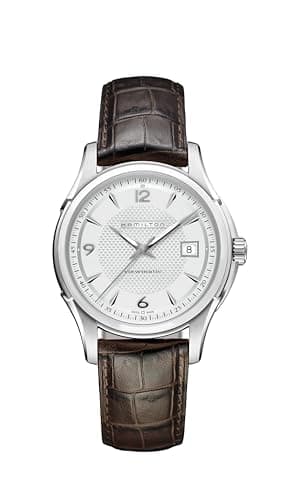
Hamilton publishes 80 hours of power reserve for the H-10 automatic in the Jazzmaster Viewmatic. Rolex publishes approximately 70 hours for calibre 3235. Both figures come from the manufacturers' own specifications, and on that measurement the Hamilton is the better watch — it will sit in a drawer over a long weekend and still be running on Monday with a margin the Rolex does not have. That is one specification out of many and we are not going to inflate it into a verdict, but it is real and it is checkable.
Where the Rolex wins decisively on the movement is accuracy: Rolex publishes −2/+2 seconds a day after casing as a certified figure. Hamilton publishes no accuracy specification for the H-10, Seiko publishes none for the 4R36, and Citizen publishes none for the Eco-Drive in the Corso — so we print nothing for any of them rather than inventing one. A certified accuracy figure on the finished watch rather than the bare movement is genuinely hard to deliver, and nothing on this page attempts it.
The case-size question, and the pick that gets closest
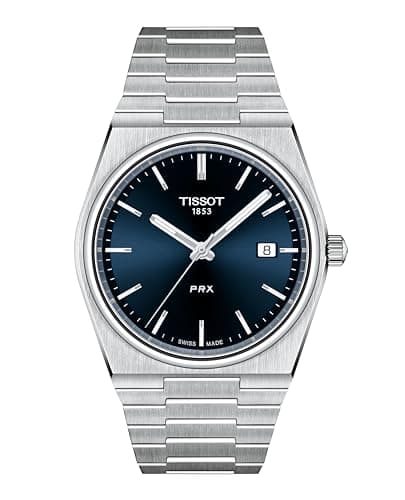
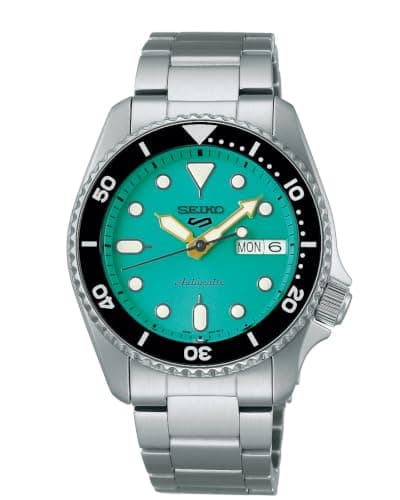
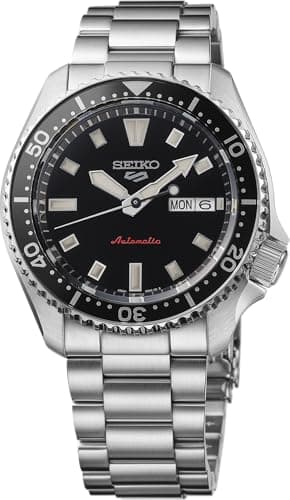
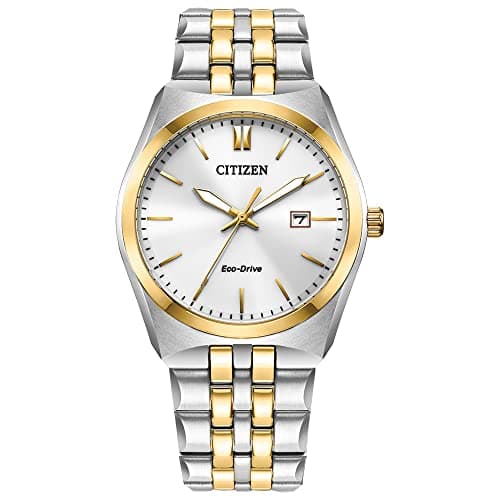
The Datejust 36 is 36mm, and a 36mm steel watch with a date is harder to find than it sounds. The closest pick here is the Seiko 5 Sports SRPK33 at 38mm with a published 44.2mm lug-to-lug, which is the shortest span on this page and the only pick we would put on a wrist under about 6.75 inches. The Hamilton is 40mm, the Tissot is 40mm, the Citizen is 40mm, and the Seiko 5 SRPE steel is 42.5mm with a 44.6mm lug-to-lug — wide, but surprisingly short across the wrist. Our watch size guide explains why we rank span over diameter, and the small-wrist page is the list if 36mm is genuinely the requirement.
Crystal and sealing, pick by pick
Sapphire: the Hamilton and the Tissot. Hardlex: both Seikos. Mineral: the Citizen. Water resistance: Rolex publishes 100m; the Tissot and both Seikos also publish 100m, and the Hamilton and the Citizen publish 50m. That is worth sitting with: the top pick on this page has the lowest water-resistance rating on it bar the budget option, and if you want a dress-steel watch you can swim in, the Tissot or either Seiko is the better answer. We would rather rank on the movement and tell you that than quietly bury it.
The bracelet, which is where the money is most visible
Rolex publishes the Jubilee as five-piece links and the Oyster as three-piece solid links, both with a folding Oysterclasp and a 5mm Easylink comfort extension link. Nothing on this page is in that league, and the bracelet is the first thing anyone who handles both will notice. Two of these picks come on a steel bracelet as standard; the Hamilton and the Tissot are the best-finished objects here. The Tissot's bracelet is integrated, which is a double-edged specification: it is why the watch looks expensive, and it is why no strap from our strap catalogue fits it. On a site built around lug width that is enough to cost it the top spot.
If what you want is a Datejust-style bracelet on a watch you already own, the honest route is a 20mm or 22mm aftermarket bracelet rather than a different watch — the bracelet roundup covers the jubilee-style and oyster-style options and is blunt about which clasps hold up.
Zero maintenance: the one thing the Rolex cannot do
The Citizen Corso is the budget pick and it has a genuine argument that no Rolex can answer: it is light-powered, so it needs no winding, no battery change and no case opening, and a Datejust needs servicing on a schedule at real cost. If you want a 40mm steel watch with a date that simply works and costs less than a single Rolex service, the solar case is strong and this is the watch.
Should you buy pre-owned instead?
The Datejust is one of the few watches where pre-owned is a serious option, because the resale market is deep and the model has been made continuously for decades. A pre-owned Datejust gets you every item on the unmatchable list, including the resale, at a discount to the $10,100 list price of the fluted white-gold reference — and it gets you an unknown service history. The picks below get you the function, nothing to worry about, and enough left over to buy a watch for every day of the week. We sell neither, and the Rolex is a better watch; most people do not need a better watch than a Jazzmaster.
What is not on this page, and why
No fluted-bezel homage and no Cyclops: we do not rank watches for imitating a design signature, which is the same position we take on the Submariner page. No Oyster Perpetual or Explorer alternatives here — the Explorer page answers the tool-watch version of this question and shares three picks with this one, with a different ranking and a different argument: that page is about a 36mm sports watch, this one is about a dress-steel watch with a date. And no Rolex: we have no Rolex listing, we would not rank a five-figure watch on an affordable site if we did, and every figure quoted for it above is Rolex's own published specification, sourced below.