This site is built around dive watches, field watches and straps — watches with a job. A dress watch is the opposite brief: it has no job except to be correct, get out of the way, and fit under a shirt cuff. That makes it the one category where the specs most of our pages rank on, water resistance and bezel action and lug-to-lug, stop being the point.
So we ranked these on a different set of criteria, in this order: how thin and how small the watch is (because a dress watch that fights a cuff has failed), dial restraint (no bezel markings, no lume plots the size of a tool watch, no date window shouting at you), what the movement actually is (a hand-wound mechanical and a solar quartz are very different objects at a similar price), and finally lug width, because a dress watch lives or dies on its strap and one of the six picks below cannot take a standard strap at all.
Water resistance deliberately sits near the bottom of that list. Four of these six are rated 30m or 50m, which in practice means rain and handwashing. That is normal and correct for the category — if you want a watch you can swim in, you want our dive watches under $500 instead, and the honest version of this page says so rather than pretending a dress watch is versatile.
One note on prices. We do not type prices into this page. Every figure you see comes from Amazon's API, stamped with the time we last checked it, so a pick that has drifted up or down since we wrote this shows you that rather than a number from months ago. In prose we stick to brackets: the Bambino and the Marlin sit in entry-level territory, the Corso, the Sun & Moon and the PRX in the middle, and the Jazzmaster well above all of them.
Thickness decides this, not diameter
Every buying guide tells you a dress watch should be small. The number that actually matters is thickness, because that is what catches on a cuff. A 40mm watch 9mm thick disappears under a shirt; a 38mm watch 13mm thick does not. This is the single reason we rank the Bambino above watches with better specifications — its domed profile and slim case do the job the category exists for.
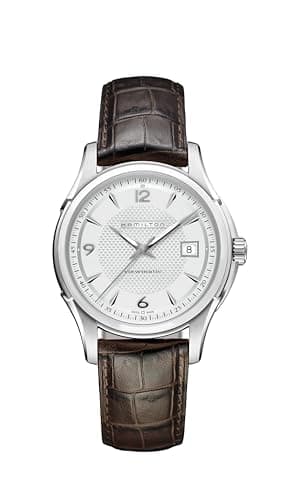
It is also the honest criticism of the Hamilton Jazzmaster Viewmatic on this page. At 40mm it is the right diameter and it carries Hamilton's 80-hour H-10 automatic and a sapphire crystal, but at around 13mm it is a thick watch by dress standards. It is a beautifully finished automatic that happens to be dressy, rather than a classic slide-under-the-cuff piece, and you should buy it knowing that.
What a restrained dial actually means
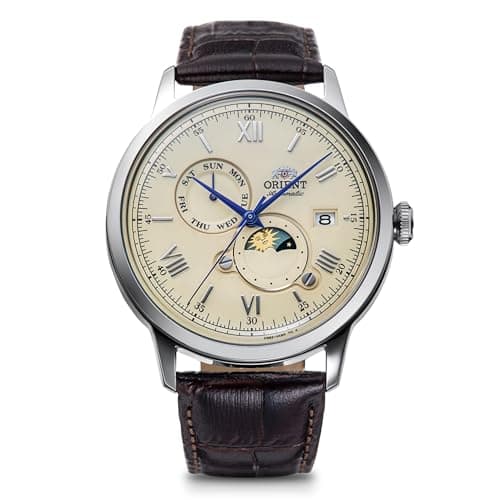
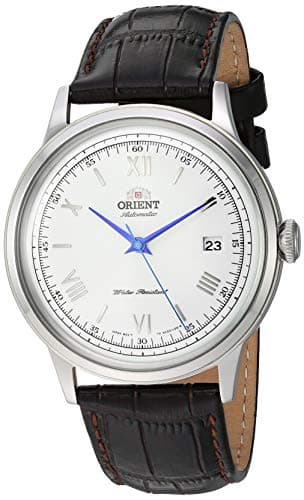
Tool watches earn their looks from markings — minute tracks, depth ratings, bezel numerals, big blocks of lume. A dress dial earns its looks by removing things. Applied indexes or simple Roman or Arabic numerals, thin hands, no bezel printing, and a date window only if it is tidy. The Bambino and the Corso both pass this test cleanly. The Orient Sun & Moon deliberately fails it in an interesting way: it adds a day-night indicator, a day wheel and a date, which is a lot of dial furniture for the category and is exactly why people buy it.
There is a related trap worth naming. A lot of watches sold as "dress" watches are sports watches with the bezel markings sanded off. If the case still has crown guards, a 44mm footprint and a rotating bezel, it is a diver in a suit. We cover what separates the two on dive watch vs dress watch.
Mechanical, solar or hand-wound?
All three are represented above, and they are genuinely different ownership experiences rather than tiers of quality.
An automatic — the Bambino, the Jazzmaster, the Sun & Moon — winds itself from your wrist and runs down over a couple of days when you take it off. It is the thing most enthusiasts want. It also keeps worse time than any quartz on this page, by a wide margin, and it needs servicing eventually.
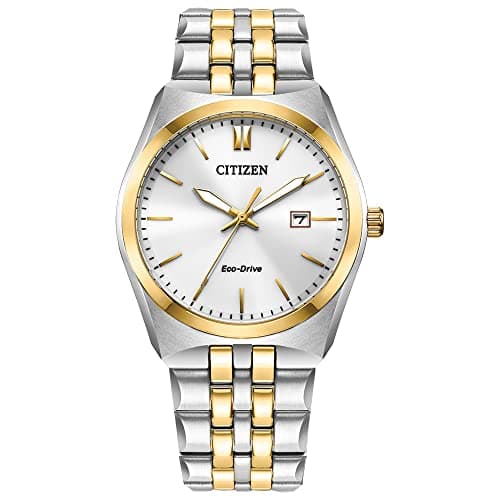
Solar quartz — the Citizen Corso — is the no-maintenance option. Eco-Drive charges from any light source, so there is no battery to replace and no winding to remember, and it keeps time to within seconds a month. If the watch is going to live in a drawer between occasions and still be right when you pick it up, this is the correct answer, and we go through the mechanism on what is Eco-Drive.
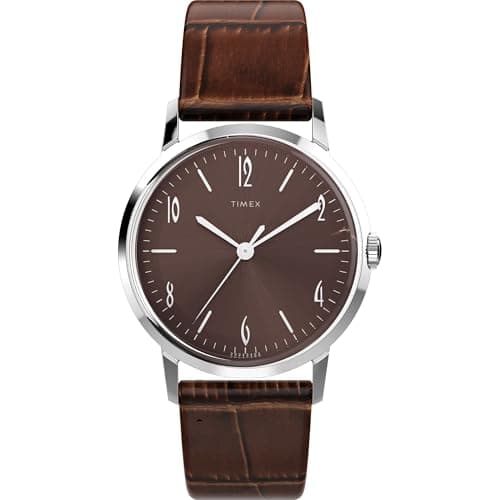
A hand-wound mechanical — the Timex Marlin — has no rotor at all. You wind it every morning, by hand, and if you forget it stops. That sounds like a flaw and for most buyers it is. For some it is the entire appeal: it is the most deliberate object on this page and the only one that makes you participate.
The water-resistance conversation, honestly
Four of these six are rated 30m or 50m. Here is what those numbers mean in use: a 30m rating covers rain, handwashing and a splash, and nothing else. It is not a swimming rating and it is not a shower rating, because hot water and soap are harder on gaskets than cold water is. A 50m rating gives you a little margin but is still not a swimming watch in our view.
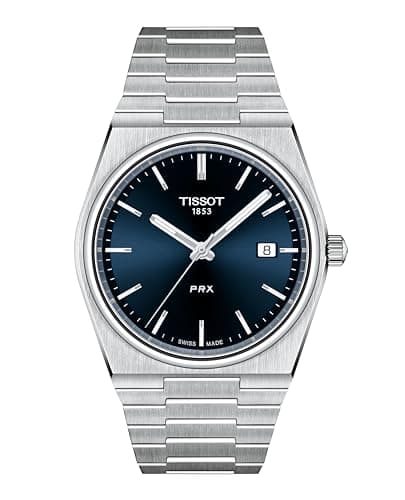
Two picks break the pattern. The Tissot PRX is rated 100m, which is a genuine everyday-water rating, and the PRX is the only watch here you could reasonably wear to a pool. That is one of the reasons it is on the list despite being the least traditional design in the group. The full explanation of what these ratings are tested for is on watch water resistance explained.
The strap question — and the one watch that fails it
A dress watch on the wrong strap looks worse than a tool watch on the wrong strap, because there is nothing else going on to distract you. The rule is simple: thin, dark, smooth leather, tapered, with a buckle that matches the case metal. A thick padded strap on a slim dress case is the most common mistake in the category, and a nylon strap on a dress watch is a different mistake in the same direction. Our best leather watch straps roundup is the shortlist, and what color watch strap handles matching it to the dial.
Now the lug widths, because they are not all convenient. The Jazzmaster and the Corso are 20mm, which is the easiest width in watches to buy for. The Marlin is 18mm, which is normal for a 34mm case and well supported. Both Orients are 21mm, which is a genuinely awkward size that many strap brands skip — plan on hunting, and check our watch lug width chart before you order. And the Tissot PRX has an integrated bracelet and no standard lug width at all: the bracelet is the design, and aftermarket straps do not fit. On a site built around lug width, that is worth saying in plain language rather than burying.
Size: this is the one category where small wins
A dress watch is the only place in watches where we will tell you to go smaller than feels natural. The Timex Marlin at 34mm is the vintage-correct size for the category and looks right on a wrist under about 6.75 inches in a way that a 42mm watch never will. The Bambino at 40.5mm and the Jazzmaster and Corso at 40mm are modern-normal. The Sun & Moon at 41.5mm is the largest here and wears it, which matters more on a dress watch than on a diver because the case is flat and wide rather than thick and sporty. If you are unsure, measure first and read watch size for wrist.
What we left off, and why
We did not include a quartz fashion-brand dress watch, even though that is what most people actually buy. At this money you can have an in-house Japanese automatic or a Swiss 80-hour movement, and a fashion-brand quartz gives you neither for the same outlay.
We also left titanium off, which is worth a sentence because it is such a common upgrade elsewhere on this site. Titanium is lighter and kinder to sensitive skin, but it reads gray and matte and will not take the bright polish a dress case wants — the full argument is on titanium vs stainless steel watch.
We also left off every watch above the Jazzmaster. There are beautiful dress watches at two and five and ten times this money, and this site does not cover them — our ceiling is roughly where best luxury watches under $1,000 stops. If you want the fuller picture of what more money buys at the top of our range, start there.