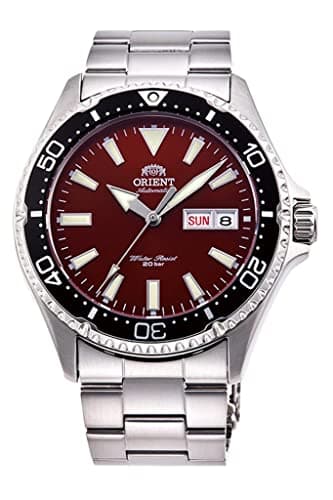
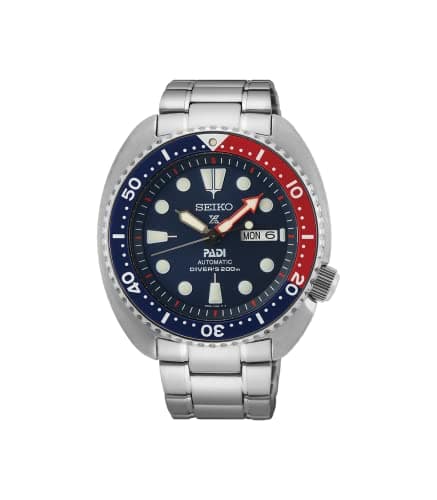
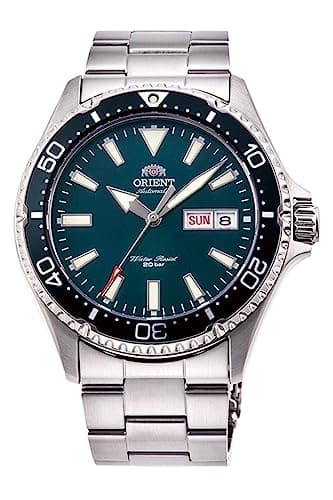
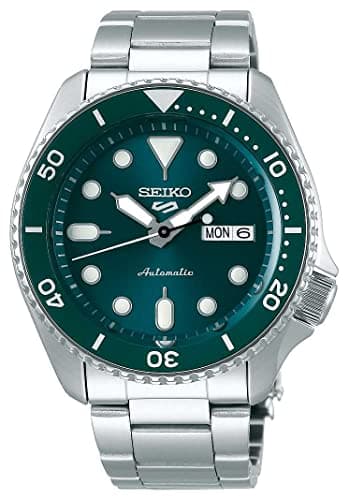
Orient is part of Seiko Epson, so this comparison is closer to choosing between two lines of the same family than between rival companies. Both build their own automatic movements, both make divers in the same price bracket, and both movements do the same things — hacking, hand-winding, day and date, roughly forty hours of reserve.
The practical difference is what you get per dollar versus what surrounds the watch. Orient consistently offers the better specification: at similar money, the Kamasu gives you 200m, a screw-down crown and a sapphire crystal where the Seiko 5 SRPD gives you 100m, no screw-down crown and Hardlex.
Seiko gives you everything that is not the specification: the lume, which is genuinely the best in affordable watches; the aftermarket, which is enormous; the resale value; and a service network you can walk into. Whether that is worth the specification gap is the actual question, and it depends on what kind of owner you are.
The movements are a draw
Seiko's 4R36 and Orient's F6922 are functionally equivalent: both are automatic, both hack and hand-wind, both carry day and date, both hold roughly forty hours, and both run within the same fifteen-to-thirty-seconds-a-day range typical of the class. Nobody should choose between these two brands on movement, and anyone who tells you one is clearly superior is expressing a preference.
Specification: Orient wins, and not narrowly
Compare like for like and Orient is ahead almost every time. Sapphire crystals appear at prices where Seiko is still fitting Hardlex. Genuine 200m ratings with screw-down crowns appear on watches that cost less than a 100m Seiko 5. If you build a spreadsheet of specs against price, Orient wins the sheet — and this is exactly why we rank the Kamasu above the SRPD on our dive pages.
Lume: Seiko wins, and not narrowly either
Seiko's LumiBrite is the best luminous material in affordable watches by a clear margin — brighter at the start and still readable hours later, on the Prospex divers in particular. If you actually use a watch in the dark, whether that is diving, night shifts or just checking the time at 3am, this is a real functional advantage and not a fan talking point.
The aftermarket, which matters more than people expect
Seiko divers are the single most modified watch category there is. Aftermarket bezels, dials, hands, crystals and straps are available in enormous variety, and there are watchmakers who do nothing else. Nothing comparable exists for Orient. If part of the appeal of an affordable watch is that you can change it, that pushes hard toward Seiko.
Service and resale
Seiko has a substantially larger US dealer and service presence, and a Seiko holds its value better on the secondhand market than an equivalent Orient. Orient's movements are well understood and independent watchmakers can service them, but the convenience gap is real. Over a ten-year ownership horizon, that is worth something.
Case sizes and fit
Orient's divers cluster around 41.5 to 41.8mm with a 47mm lug-to-lug — one of the more wearable brackets in diving. Seiko's range is wider and skews larger: the SRPD is 42.5mm, the Prospex Turtle is 45mm, and Seiko's 38mm Seiko 5 Sports is the smaller answer if you need one. On a wrist under about 6.75 inches, look at the Orients or the 38mm Seiko first.
The verdict
Buy Orient if you want the most watch for the money and you are content to own it as it came. Buy Seiko if you want the best lume, the ability to modify, better resale, easier service or simply a name people recognize. Both are honest recommendations and there is no wrong answer — but if a friend asked us for a first automatic and had no other requirements, we would hand them the Kamasu and tell them to spend the difference on straps. The model-level version of that decision — the Kamasu against the Seiko 5 Sports SRPD, separator by separator — is on Orient Kamasu vs Seiko 5 SRPD.